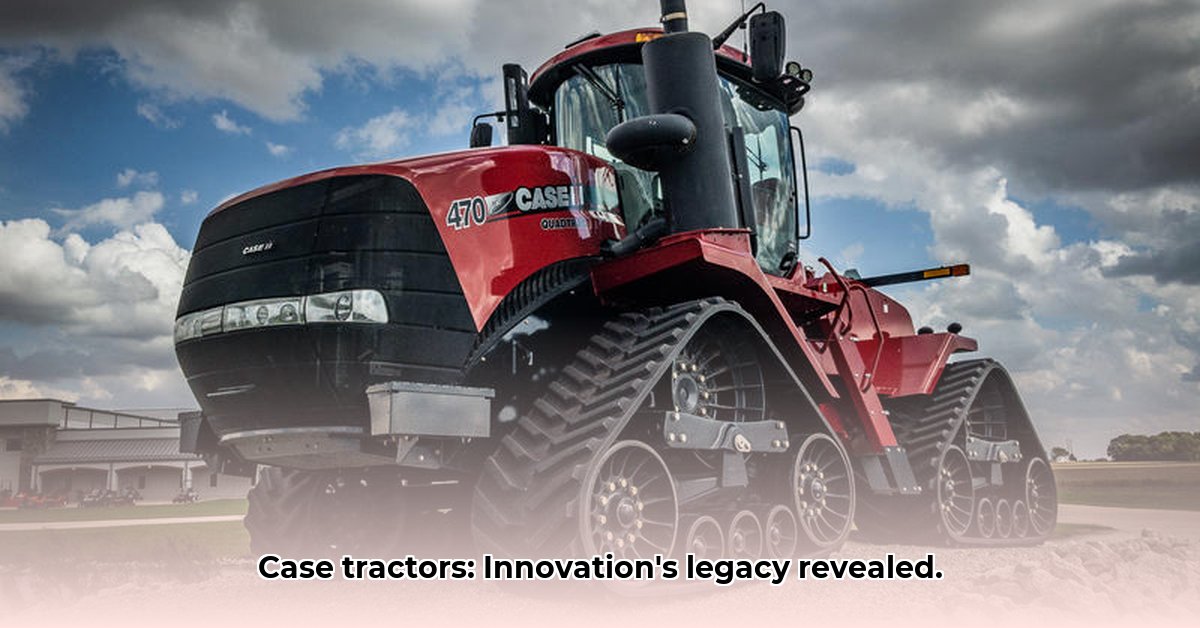
From Steam Power to Sustainable Solutions: A Century of Case Tractors
The story of Case tractors is a compelling narrative of agricultural innovation, mirroring the evolution of farming from labor-intensive practices to the technologically advanced operations of today. This journey, however, is not solely about technological advancements; it's also about the ongoing quest to balance food production with environmental stewardship. This article explores Case's pivotal moments, examining the technological leaps, their impact on farming practices, and their implications for sustainability. For more information on Case's manufacturing locations, check out Case tractor manufacturing.
The Dawn of Mechanization: Early Innovations and Environmental Trade-offs
Imagine the early 20th century: vast fields worked by manual labor, a stark contrast to the efficiency of modern farming. Case's early steam-powered tractors were revolutionary, dramatically increasing planting and harvesting speeds and boosting crop yields. This mechanization allowed farmers to cultivate more land, feeding a growing population. However, this progress came at a cost. The massive steam engines were fuel-intensive, contributing significantly to pollution. Simultaneously, the increased efficiency led to intensified land use, potentially impacting natural habitats. This early stage showcases a recurring theme: the inherent tension between agricultural productivity and environmental impact. “The early adoption of steam power was a pivotal moment, demonstrating both the potential and the challenges of agricultural mechanization,” notes Dr. Emily Carter, Professor of Environmental Engineering at Stanford University.
Did this early success come at too high an environmental cost? This question remains a subject of ongoing debate.
The Case-IH Merger: A Giant Leap with Unforeseen Consequences
1985 marked a decisive moment: the merger of Case and International Harvester, forming Case IH, an agricultural behemoth. This consolidation immediately expanded Case's reach, bringing its machinery to a vastly larger farmer base across numerous regions. The merger resulted in increased production, enhanced distribution networks, and substantial market power. Yet, some argue that this increased scale potentially stifled innovation in specific areas, possibly diverting resources from environmentally friendlier technologies. This period highlights a complex interplay between economic benefits and potential limitations in the pursuit of sustainable practices. "Scale isn't always synonymous with sustainability," cautions Professor David Klein, Director of the Center for Sustainable Agriculture at Cornell University. "It’s crucial to balance growth with responsible innovation."
What were the long-term impacts of this significant merger on Case's commitment to sustainability? Further research is needed to fully assess the ramifications.
Precision Farming: A Paradigm Shift Towards Sustainability
Recent decades have witnessed a notable shift towards precision agriculture, a technological approach that uses GPS, sensors, and data analytics to optimize farming. Instead of broad applications of resources, precision farming enables targeted interventions, using only the necessary amount of fertilizer, pesticides, and water, where and when needed. Case IH’s Advanced Farming Systems (AFS) exemplify this technology. This precision significantly reduces resource waste, minimizes environmental impact, and enhances efficiency. However, concerns remain surrounding data security and the high initial investment required for implementation. "Precision agriculture offers immense potential, but data privacy and accessibility remain key challenges," states Dr. Anya Petrova, a leading expert in Sustainable Agricultural Technology at the University of California, Berkeley.
How significant is the reduction of environmental impact through the AFS technology? Quantifiable studies are needed to assess the actual long-term effects.
Powering the Future: Electrification and Autonomous Systems
The future trajectory of Case IH hinges on successfully navigating the ongoing balance between feeding a growing global population and protecting the environment. The company is actively pursuing alternative power sources, focusing on electric and hydrogen-powered tractors. While still in development, these technologies could drastically cut emissions. The development of autonomous systems, where tractors operate without a driver, promises further efficiency gains and potential labor cost reductions. However, numerous technical and economic hurdles need to be addressed. The success of this transition depends on collaborative efforts and careful management of the various challenges.
Case Tractor History: A Timeline of Innovation and Environmental Impact
| Year | Event | Technological Advancement | Environmental Impact |
|---|---|---|---|
| Early 1900s | Introduction of steam-powered tractors | Steam power for increased efficiency | High fuel consumption, land use intensification, pollution |
| 1985 | Merger with International Harvester (IH) | Increased production scale, broader product line | Potential for increased emissions, potential impact on innovation |
| Present | Adoption of precision agriculture (AFS) | Optimized resource utilization, reduced waste | Reduced resource consumption (potential), data security concerns |
| Future | Electric/Hydrogen tractors, autonomous systems | Shift towards alternative fuels, automated farming | Reduced emissions (potential), technological hurdles to overcome |
Navigating the Future: Sustainability and the Case IH Legacy
The Case IH story underscores the ongoing tension between maximizing agricultural productivity and minimizing environmental harm. Early innovations, while undeniably beneficial, generated environmental concerns. The path forward necessitates continuous innovation, collaborative partnerships, and a fundamental commitment to sustainable farming practices. This ongoing effort, requiring considerable research and development, aims towards a future where agricultural growth harmonizes with environmental protection. The narrative is far from over; it's a continuously evolving story of adaptation and ingenuity.